
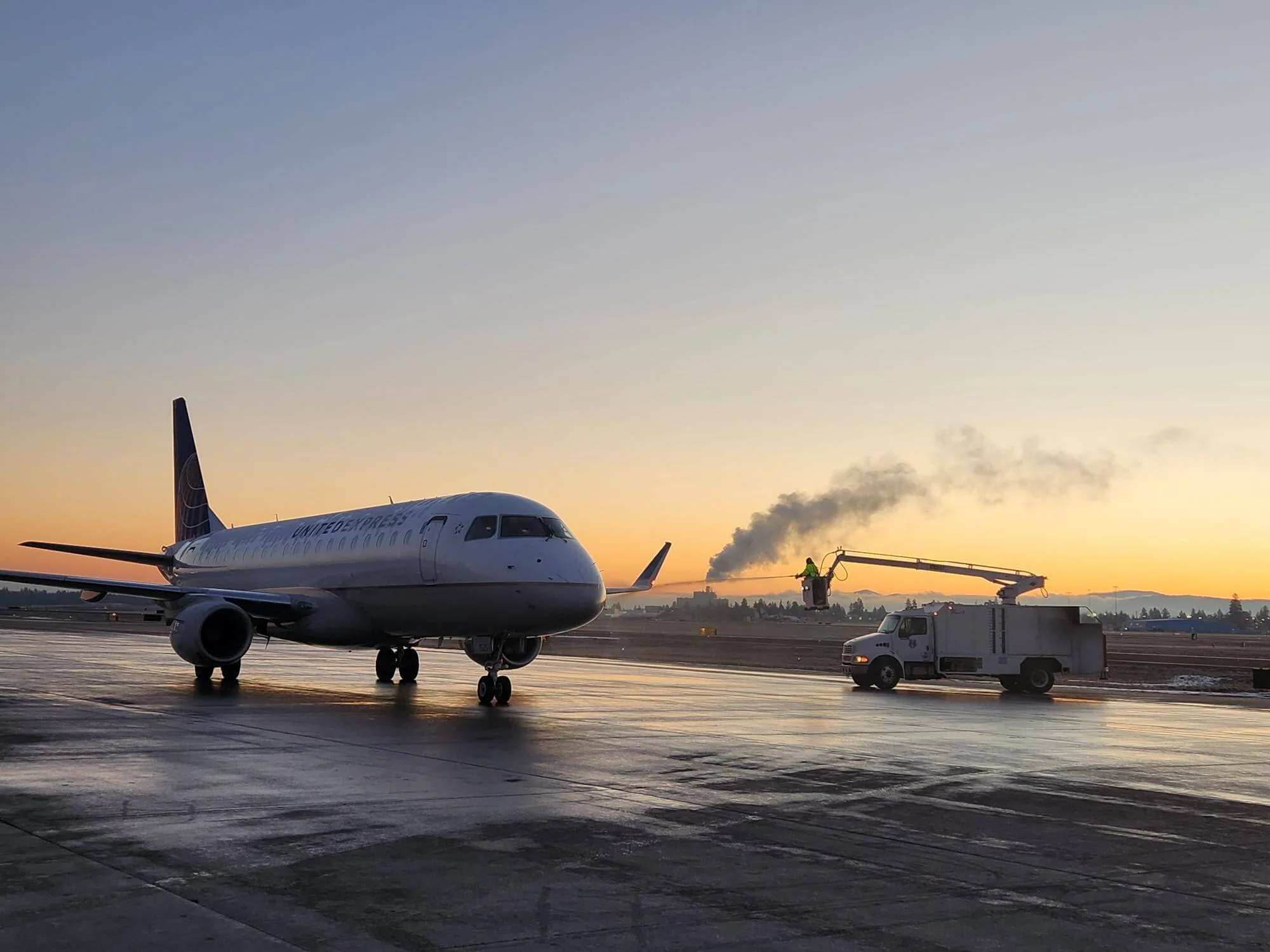
What is the de-icing and stormwater program?
Spokane International Airport has pioneered a sustainable, science-based method for managing aircraft de-icing fluid. In partnership with the Washington State Department of Ecology. The Airport collects and stores spent de-icing fluid applied by commercial airline carriers, then applies it to a land treatment site where it naturally breaks down.
De-icing is essential for flight safety. Snow and ice buildup can disrupt the aerodynamics needed for a safe takeoff, and the FAA requires commercial carriers to apply de-icing fluid before departure in freezing conditions.
At Spokane International Airport, we’ve developed a sustainable approach to managing the spent fluid that results from this process — one that protects the environment without compromising safety or compliance.
The Airport operates three glycol recovery vehicles (GRVs) that collect spent de-icing fluid from ramps and taxiways after airlines de-ice their aircraft.
Collected fluid and stormwater are stored through the winter months, then applied to a designated land treatment site each spring. Naturally occurring soil microbes safely break down the compounds before they can reach groundwater — eliminating the need for costly off-site treatment.
This land application process has been in active development and testing since 2011, in close collaboration with the Washington State Department of Ecology.
After nine years of successful pilot testing, the Washington State Department of Ecology issued Spokane International Airport a permanent permit-by-rule in 2020. Ongoing monitoring has shown no adverse effects to groundwater quality — and in some areas, measurable improvements.
The program delivers four key benefits:
- Reduces the risk of groundwater contamination
- Minimizes pollutant loads in stormwater runoff
- Avoids the cost of off-site treatment and disposal
- Preserves flight safety while meeting FAA and Ecology standards
Read the Letter of Support from Washington State Department of Ecology
De-icing fluid is a biodegradable compound made of propylene glycol and water.
De-icing fluid has a holdover time, meaning its effectiveness decreases over time. For this reason, de-icing fluid is applied when a plane is ready for departure, either at the gate after pushback or at a designated de-icing pad on the ramp.
De-icing fluid is also sprayed onto public roadways as a preemptive measure to prevent ice and snow buildup.
Ensuring safety and efficiency, especially in winter weather conditions, takes a team! Airlines are responsible for managing their own aircraft de-icing operations. This includes purchasing, storing, and applying de-icing fluid to their planes, while the Airport maintains responsibility for keeping runways, taxiways, and ramps clear of snow and ice. The Airport also plays an important role in the safe disposal of spent de-icing fluid.
A Glycol Recovery Vehicle (GRV) is a specialized vehicle that collects slush and water containing spent de-icing fluid from the Airport’s ramps, taxiways, runways, and other areas…in other words, a really large airfield vacuum. The Airport currently owns and operates three GRVs, each with a capacity of 1,000–2,000 gallons.
Land application uses natural soil processes to break down de-icing compounds. After a multi-year pilot, Ecology confirmed the method improves groundwater quality.
No. De-icing fluid is a biodegradable compound made of propylene glycol and water.